

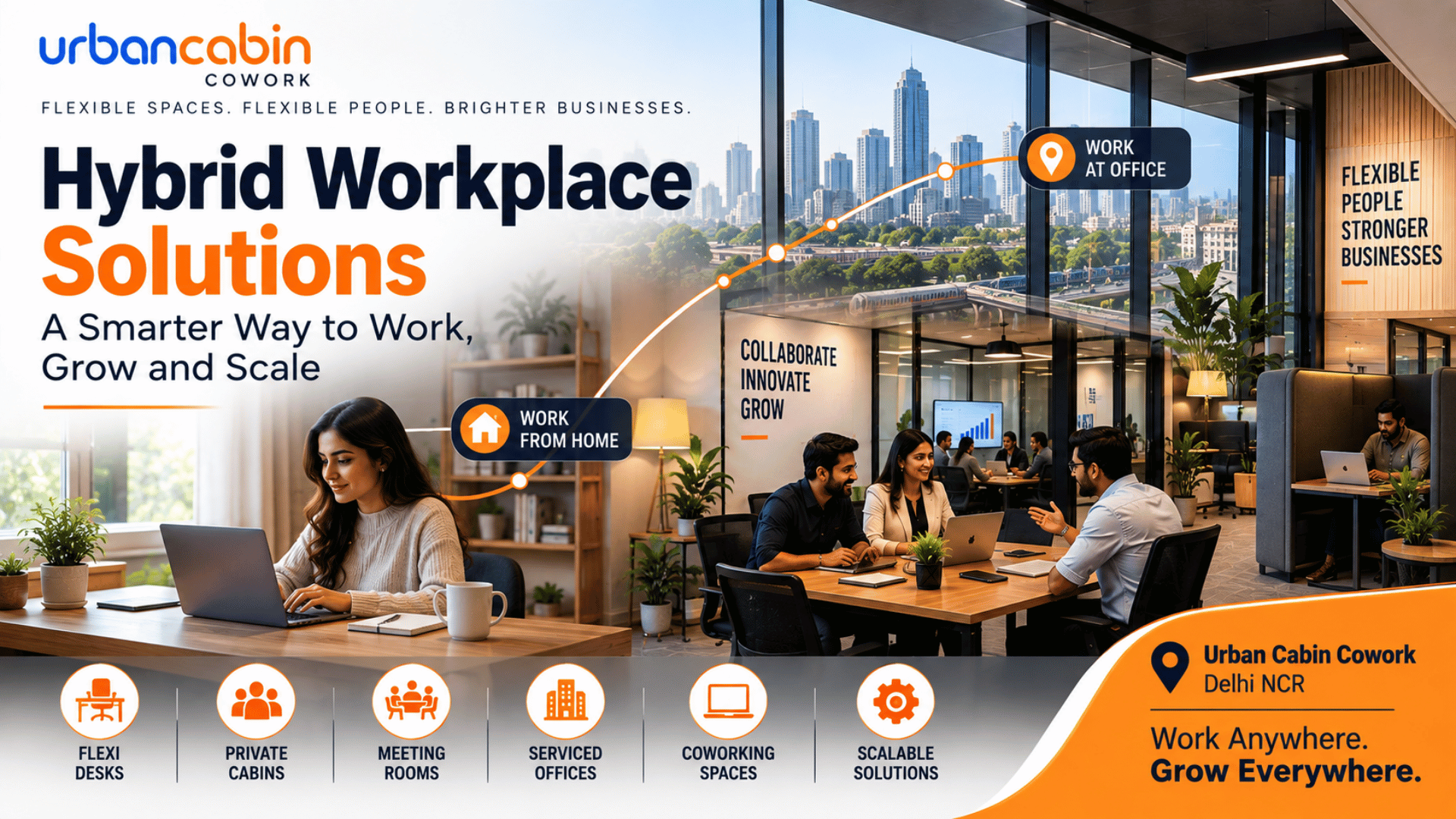
Hybrid Workplace Solutions
Hybrid Workplace Solutions: How Companies Create Hybrid Work Policies Using Flexible Offices
A hybrid workplace solution combines a company’s hybrid work policy with the physical and digital infrastructure employees need to work effectively from different locations. Flexible offices help companies provide desks, private cabins, meeting rooms, and collaboration spaces without requiring every employee to have a permanently assigned workstation.
For startups, SMEs, remote teams, and growing businesses, this approach can make office space more adaptable to changing attendance patterns and team requirements.
What Are Hybrid Workplace Solutions?
Hybrid workplace solutions are workspace and operational arrangements that support employees working partly from home and partly from a physical office.
A complete hybrid workplace can include:
- Flexible office space
- Flexi and fixed desks
- Private offices or cabins
- Meeting and collaboration rooms
- Serviced offices
- Coworking spaces
- Remote-work infrastructure
- Workspace access and scheduling systems
The objective is simple: give employees an appropriate place to work while allowing companies to adjust workspace according to business needs.
How Do Companies Create a Hybrid Work Policy?
A practical hybrid work policy should clearly define where employees work, when they are expected to collaborate in person, and how teams will use office resources.
1. Identify Which Roles Can Work Remotely
Companies should first determine which roles can effectively work remotely and which require regular office access. Software teams, consultants, marketing professionals, and other knowledge workers may have different workplace requirements.
2. Decide When Teams Need to Be Together
Companies can establish collaboration days for team meetings, project planning, training, client discussions, or important workshops. These requirements help determine how much physical office space a team actually needs.
3. Define Office and Remote Expectations
A hybrid work policy should explain:
- Expected office days
- Remote-work arrangements
- Working hours
- Communication requirements
- Meeting expectations
- Data and security responsibilities
Clear rules prevent employees and managers from having different interpretations of the hybrid work model.
4. Match Workspace to Actual Attendance
Instead of maintaining a permanent desk for every employee, companies can use flexible workspace solutions that match office capacity with actual attendance.
For example, employees who visit occasionally may use flexi desks, while teams that need consistent space can use fixed desks or private cabins.
How Do Flexible Offices Support Hybrid Teams?
Flexible offices support hybrid teams by providing workspace when employees need it without requiring companies to maintain a permanently assigned workstation for everyone.
Different workplace requirements can be matched with different flexible office solutions:
| Hybrid team requirement | Flexible office solution |
| Occasional office visits | Flexi desk |
| Regular office attendance | Fixed desk |
| Dedicated team workspace | Private cabin |
| Client or team meetings | Meeting room |
| Growing team | Serviced office |
| Training or company events | Event space |
This makes flexible offices useful for companies whose employee attendance changes throughout the week.
For example, a remote team may work from home most days but use a professional meeting room for weekly collaboration. A growing startup may use coworking desks initially and move into a private office as the team expands.
Why Should Companies Use Flexible Offices for Hybrid Work?
Flexible office solutions give hybrid teams access to professional workspace while allowing companies to adapt their office footprint to changing business requirements.
The main advantages include:
Better workspace utilization
Companies can align office capacity with actual employee attendance instead of maintaining unused workstations.
Greater flexibility
Teams can choose different workspace options based on their work patterns, team size, and collaboration requirements.
Easier collaboration
Meeting rooms, private cabins, and shared workspaces give distributed employees professional locations for face-to-face collaboration.
Scalable office infrastructure
Flexible workspace allows growing companies to add desks, cabins, or office capacity as their requirements change.
Flexible Office vs Traditional Office for Hybrid Teams
| Factor | Flexible office | Traditional office |
| Workspace commitment | More adaptable | Usually more fixed |
| Hybrid attendance | Easier to accommodate | Requires more planning |
| Expansion | Can scale with requirements | May require additional premises |
| Meeting space | Available according to need | Usually dedicated |
| Dedicated workspace | Private cabins or offices available | Typically built into the lease |
| Suitable for | Variable or growing teams | Stable office requirements |
Neither model is universally suitable for every company. The right workplace strategy depends on team size, office attendance, privacy requirements, collaboration needs, growth plans, and budget.
How Can HR Teams Build a Hybrid Workplace Strategy?
A simple framework is:
Assess → Define → Allocate → Measure → Adjust
Assess: Understand employee roles, attendance patterns, and collaboration requirements.
Define: Create clear hybrid work policies covering office attendance, remote work, communication, and collaboration.
Allocate: Select the right combination of flexi desks, fixed desks, private cabins, meeting rooms, or serviced offices.
Measure: Review workspace utilization, employee feedback, and team requirements.
Adjust: Change the workspace arrangement as the company’s workforce and hybrid work model evolve.
This approach connects the hybrid work policy with the physical workplace instead of treating them as separate decisions.
How Can Flexible Workspace Solutions Support Hybrid Teams in Delhi NCR?
Urban Cabin Cowork provides flexible workspace solutions for hybrid teams, helping businesses match their office requirements with changing employee attendance and business needs.
Businesses can choose from flexi desks, fixed desks, private cabins, meeting rooms, and serviced offices to support different hybrid work models. Teams can use flexi desks for occasional office days, private cabins for focused team work, and meeting rooms for collaboration, client meetings, and in-person sessions.
For companies in Delhi NCR and Gurugram, flexible office space provides a practical way to bring remote and office-based employees together without requiring a permanent workstation for every employee. This makes flexible workspace solutions especially useful for startups, SMEs, remote teams, and growing businesses implementing hybrid workplace strategies.
Explore Coworking Spaces in Delhi NCR
Looking for a Coworking Space in Delhi NCR? Discover top-rated options across the city:
Coworking Space in Central Delhi | Coworking Space on Pusa Road | Coworking Space in Jhandewalan | Coworking Space in Karol Bagh | Coworking Space in Rajendra Place | Coworking Space in Old Rajinder Nagar | Coworking Space in Connaught Place | Coworking Space in Gurugram | Coworking Space in Udyog Vihar


Leave a Reply