

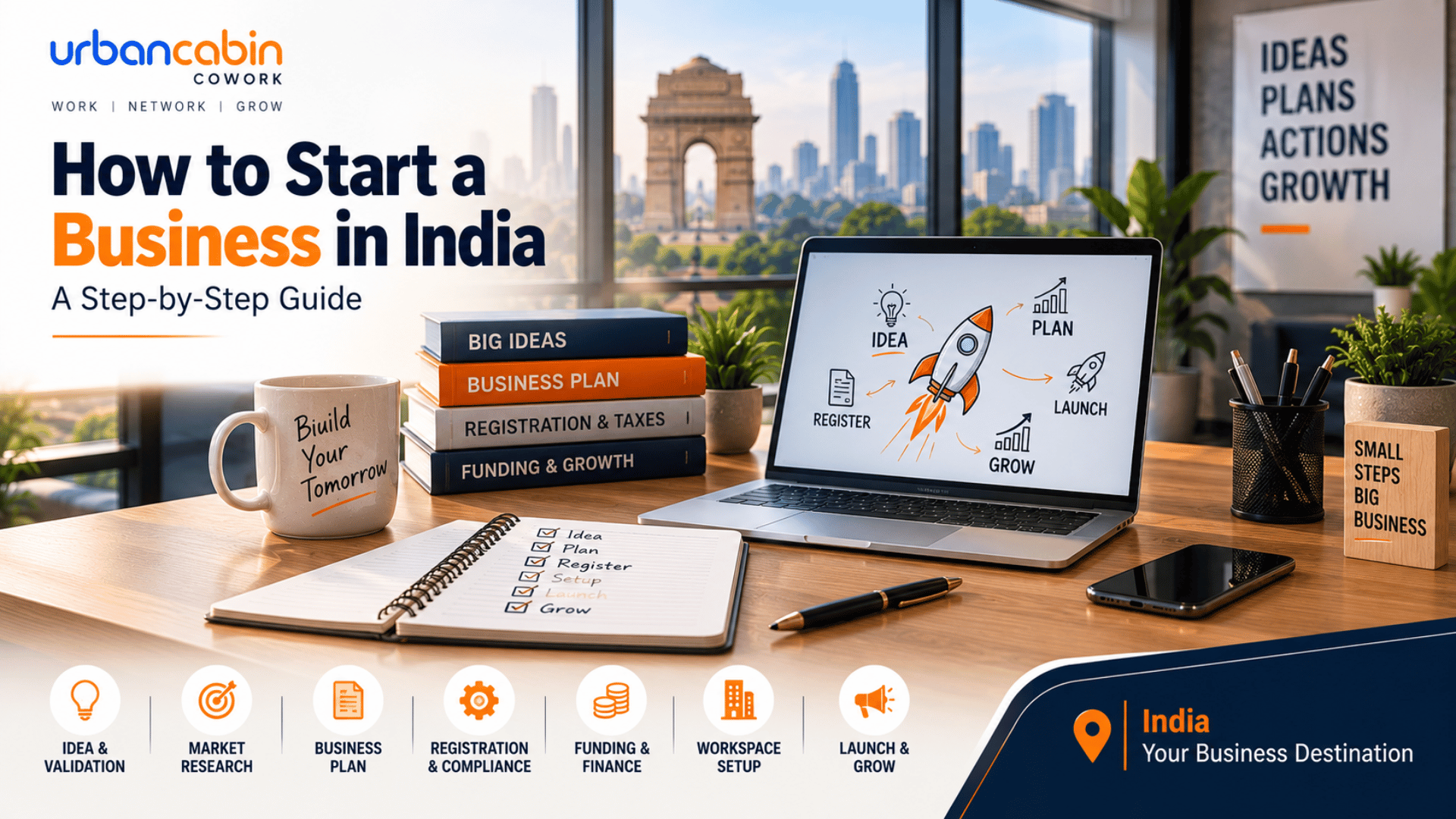
How to Start a Business in India
How to Start a Business in India in 2026: A Step-by-Step Guide
Starting a business in India can be an exciting opportunity, whether you want to launch a startup, build a small business, work as a freelancer, or turn an existing idea into a full-time venture.
But having a business idea is only the beginning. You also need to validate your idea, understand your customers, choose an appropriate business structure, complete applicable registrations, manage taxes and compliance, and create a practical setup for operating the business.
So, how do you start a business in India?
The process depends on your business model, industry, location and chosen legal structure. This guide explains the major steps involved, from developing your business idea to choosing a business address and workspace.
Note: Registration, tax and licensing requirements can vary depending on the nature of your business. Always verify the requirements applicable to your specific business with the relevant government authority or a qualified professional.

How to Start a Business in India: Quick Overview
For most new entrepreneurs, the business setup journey can be broadly divided into these steps:
- Identify and validate your business idea
- Research your market and customers
- Create a basic business plan
- Choose a suitable business structure
- Select your business name
- Complete the relevant business registration
- Obtain applicable tax registrations
- Check industry-specific licences and approvals
- Consider MSME/Udyam or Startup India registration where eligible
- Open a business bank account
- Choose a business address and workspace
- Set up your website and online presence
- Establish accounting and compliance processes
- Launch your business and acquire customers
- Maintain ongoing legal and financial compliance
The exact sequence may differ depending on whether you are establishing a proprietorship, partnership, LLP, private limited company or another type of entity.
Top 15 Checklist: How to Start a Business in India in 2026
1. Start With a Business Idea
Before worrying about registration, decide what you are actually going to sell and who you are going to sell it to.
A strong business idea generally solves a specific customer problem or meets a clear market demand.
Identify a Problem You Can Solve
Ask yourself:
- What problem does my product or service solve?
- Who experiences this problem?
- How are people solving it currently?
- What can I offer that is different or more convenient?
- Are customers willing to pay for the solution?
Your business could be a product company, professional service, consulting business, agency, ecommerce operation, technology startup, local service or another type of venture.
Research Your Market
Market research can help you understand:
- Your target customers
- Existing competitors
- Market pricing
- Customer expectations
- Demand patterns
- Potential opportunities
- Barriers to entry
For example, if you want to start a digital marketing agency, research the types of businesses that need your services, the services competitors offer, typical pricing models and the industries you could specialise in.
2. Create a Basic Business Plan
You do not necessarily need a 50-page business plan to get started.
A practical business plan should explain how your business will operate and make money.
Include:
Business Model
Define:
- What you sell
- Who your customers are
- How customers will find you
- How you will deliver your product or service
- How you will generate revenue
Startup Costs
Estimate your initial and recurring expenses.
These could include:
- Business registration
- Professional services
- Website development
- Software
- Equipment
- Employees or freelancers
- Marketing
- Workspace
- Business travel
- Accounting
- Insurance
- Inventory, where applicable
Revenue Expectations
Estimate:
- Expected customers
- Average order value
- Monthly revenue
- Recurring revenue
- Gross margins
- Major operating expenses
You do not need perfect numbers at the beginning. The objective is to create a realistic starting model that you can improve as you learn more about your market.
3. Choose the Right Business Structure
One of the most important decisions when starting a business in India is choosing an appropriate legal structure.
Common structures include:
- Sole proprietorship
- Partnership firm
- Limited Liability Partnership (LLP)
- Private Limited Company
- One Person Company (OPC)
- Other structures applicable to particular situations
Startup India identifies several business structures and notes that the choice can affect areas such as taxation, compliance and fundraising.
Sole Proprietorship
A sole proprietorship is operated by one individual.
It can be relevant for certain small businesses and individual entrepreneurs, but the owner and business are not separate legal persons in the same way as a company.
Partnership Firm
A partnership can be suitable where two or more individuals operate a business together under a partnership arrangement.
The applicable registration and legal requirements should be checked based on the business and state.
Limited Liability Partnership
An LLP combines elements of partnership-style management with limited liability for its partners, subject to applicable law.
It can be considered by professional firms, service businesses and other ventures where the structure fits the founders’ requirements.
Private Limited Company
A private limited company is a separate legal entity incorporated under the Companies Act.
It is commonly considered by startups and businesses planning to build a larger organisation, raise investment or establish a formal corporate structure.
One Person Company
An OPC provides a corporate structure for a single-member business subject to the applicable legal requirements.
Which Structure Should You Choose?
There is no single business structure that is right for every entrepreneur.
Consider:
- Number of founders
- Liability considerations
- Funding plans
- Compliance requirements
- Tax implications
- Business scale
- Ownership requirements
- Long-term goals
For an important structural decision, consider consulting a qualified company secretary, chartered accountant or legal professional.
4. Choose and Register Your Business Name
Your business name becomes an important part of your identity, so choose it carefully.
Before finalising a name, consider:
- Whether it is distinctive
- Whether customers can remember it
- Whether the relevant registration route permits it
- Trademark considerations
- Domain-name availability
- Social-media availability
- Whether it could be confused with another brand
A business name should ideally be easy to pronounce, spell and remember.
If you plan to build a long-term brand, it is worth checking intellectual-property considerations before investing heavily in branding.
5. Register Your Business
The registration process depends on the structure you choose.
For example, company and LLP incorporation follows a formal process, while other business structures may have different registration requirements.
Depending on your business, you may need documentation such as:
- PAN
- Identity documents
- Address proof
- Business details
- Registered-office details
- Incorporation documents
- Partnership documents, where applicable
Startup India notes that entrepreneurs should select the appropriate structure and complete the relevant registration process.
Business Registration in India: What Should You Check?
Before submitting an application, verify:
- Your chosen legal structure
- Name requirements
- Founder/owner documentation
- Registered-office requirements
- Applicable tax registrations
- Industry-specific approvals
- Ongoing compliance obligations
Do not assume that registering a business automatically completes every tax, licence or regulatory requirement.
6. Get the Tax Registrations Your Business Requires
Tax obligations depend on your business activities, turnover, structure and other circumstances.
PAN and TAN
Your business may need appropriate PAN and, where applicable, TAN arrangements depending on its structure and activities.
GST Registration
GST registration is required when the business falls within the applicable GST rules.
The requirement is not identical for every new business. Turnover, type of supply, location and other circumstances can affect applicability.
Therefore, do not simply assume that every startup needs GST registration immediately.
The GST framework should be checked against the current rules applicable to your particular business.
Keep Tax Records
Once you begin operating, establish a system for:
- Invoices
- Expenses
- Revenue
- Tax records
- Bank transactions
- Supporting documents
Good record-keeping from the beginning can make future accounting and compliance much easier.
7. Consider MSME/Udyam Registration
If your business qualifies as a Micro, Small or Medium Enterprise, you can consider Udyam Registration.
The official Udyam Registration portal states that MSME registration is free, online, paperless and based on self-declaration. It also issues a permanent Udyam Registration Number and online certificate after successful registration.
The MSME classification criteria were revised from April 1, 2025. The current official portal lists:
- Micro: investment up to ₹2.5 crore and turnover up to ₹10 crore
- Small: investment up to ₹25 crore and turnover up to ₹100 crore
- Medium: investment up to ₹125 crore and turnover up to ₹500 crore
Eligibility and applicability should always be checked against the latest official requirements.
8. Explore Startup India and DPIIT Recognition
If you are building an eligible startup, you may also explore DPIIT Startup Recognition under Startup India.
Startup India currently states that eligible entities can include private limited companies, registered partnership firms, LLPs and certain cooperative societies, subject to the applicable criteria.
Recognition is not the same thing as ordinary business registration.
It is a separate recognition process with its own eligibility conditions.
Potentially relevant areas include:
- Startup recognition
- Intellectual property support
- Government programmes
- Procurement-related benefits
- Certain tax-related benefits, where separately eligible
Always check the current eligibility criteria before applying because government rules and thresholds can change.
9. Check Industry-Specific Licences and Approvals
Not every business needs the same licences.
Your requirements can depend on:
- Industry
- State
- Business activity
- Location
- Products
- Employees
- Environmental considerations
- Import/export activity
- Food handling
- Manufacturing
- Other regulatory factors
For example, a food business can have very different requirements from a software consultancy.
How Can You Find the Approvals You Need?
The National Single Window System (NSWS) provides a platform for identifying and applying for various central and state business approvals.
Its Know Your Approvals functionality helps entrepreneurs identify approvals based on business characteristics. NSWS currently provides access to approvals across multiple central ministries and states/UTs.
This can be a useful starting point when determining what permissions your particular business may require.
10. Open a Business Bank Account
Once your business setup is underway, establish an appropriate banking arrangement.
A dedicated business/current account can help you separate business transactions from personal finances.
You may need documents relating to:
- Business registration
- PAN
- Identity/address
- Business constitution
- Authorised signatories
Requirements vary by bank and business structure.
Why Separate Business Finances?
Keeping business finances organised makes it easier to:
- Track revenue
- Monitor expenses
- Prepare accounts
- Reconcile transactions
- Manage taxes
- Understand cash flow
This becomes increasingly important as your business grows.
11. Choose a Business Address and Workspace
Your workspace can have a significant impact on how you operate your business.
But starting a business does not necessarily mean signing a long-term traditional office lease immediately.
Your options can include:
- Working from home
- Coworking spaces
- Private cabins
- Private offices
- Serviced offices
- Managed offices
- Virtual office solutions
- Hybrid workspace arrangements
The right option depends on your team size, customer requirements, budget and working model.
Do You Need a Physical Office?
Not every business needs a conventional office from day one.
A freelancer, consultant, online business or remote-first startup may be able to operate with a flexible setup.
On the other hand, businesses that regularly meet clients, employ teams or require dedicated workspaces may benefit from a physical office.
What Is a Professional Business Address?
A professional business address can provide a formal location for business correspondence and other legitimate business purposes, subject to the applicable rules.
For entrepreneurs who do not need a full-time office, a virtual-office solution can provide a more flexible approach to maintaining a professional business presence.
What Is a Virtual Office?
A virtual office is a workspace service that can provide certain business-address and support services without requiring you to rent a conventional dedicated office full-time.
Depending on the provider and plan, services can include:
- Professional business address
- Mail or courier handling
- Meeting-room access
- Workspace access
- Reception support
- Other business services
If you are considering a virtual office for registration or tax purposes, always confirm that the specific address and documentation meet the requirements applicable to your use case.
When Should You Consider Coworking or Private Office Space?
Coworking can be useful when you need:
- A professional working environment
- Flexible seating
- Networking opportunities
- Meeting rooms
- A place to work outside your home
A private office or cabin can be more appropriate when you need:
- Dedicated space
- Privacy
- Team collaboration
- Client meetings
- A more controlled working environment
For startups and growing teams, flexible workspace can also help avoid committing to a large conventional office before the team size and business requirements are clear.
12. Build Your Online Presence
Once your business foundation is established, create a professional digital presence.
Build a Business Website
Your website should clearly communicate:
- What you offer
- Who you serve
- Why customers should consider you
- How customers can contact you
Set Up Professional Email
A professional email address using your business domain can help create a consistent brand presence.
Create Relevant Business Profiles
Depending on your business, consider relevant:
- Google Business Profile
- Social media profiles
- Industry directories
- Marketplace profiles
- Professional networking profiles
Start SEO Early
Search engine optimisation can help potential customers discover your business when they are actively looking for your products or services.
Start with:
- Keyword research
- Useful website content
- Location pages where relevant
- Service pages
- FAQs
- Internal linking
- Technical SEO
- Helpful blog content
13. Set Up Accounting and Compliance Systems
Do not wait until your first tax deadline to think about accounting.
Set up systems for:
- Invoicing
- Expense management
- Bank reconciliation
- Bookkeeping
- Payroll, where applicable
- Tax records
- Contracts
- Receipts
- Compliance calendars
The exact compliance obligations will depend on your entity and activities.
For companies, for example, ongoing corporate compliance can be significantly different from that of an individual proprietor.
A qualified accountant or company secretary can help you establish an appropriate compliance process.
14. Launch Your Business and Find Your First Customers
Once the operational foundation is ready, focus on getting your first customers.
Define Your Ideal Customer
Create a clear profile of:
- Who your customer is
- What problem they have
- What they currently use
- What they are willing to pay
- Where they search for solutions
Choose Your Marketing Channels
Depending on your audience, these could include:
- SEO
- Google Ads
- Social media
- Email marketing
- Partnerships
- Referrals
- Networking
- Content marketing
- Events
Collect Customer Feedback
Your first customers can help you understand:
- What works
- What does not
- What features matter
- What objections customers have
- What you should improve
Use this feedback to refine your offering.
15. Common Mistakes to Avoid When Starting a Business in India
Starting a business can become complicated when entrepreneurs overlook basic planning.
Mistake 1: Choosing a Structure Without Understanding It
Do not choose a structure simply because another entrepreneur uses it.
Consider ownership, liability, compliance, taxation and future plans.
Mistake 2: Ignoring Applicable Licences
Different industries can have different regulatory requirements.
Check the approvals relevant to your particular activity.
Mistake 3: Mixing Personal and Business Money
Keep your business transactions organised from the beginning.
Mistake 4: Underestimating Operating Costs
Your business may need months to reach sustainable revenue.
Plan for recurring expenses rather than only initial setup costs.
Mistake 5: Taking Too Much Office Space Too Early
A large conventional office may not be necessary for a small or remote-first team.
Consider flexible workspace options until your requirements become clearer.
Mistake 6: Ignoring Accounting
Poor records can make financial management and compliance harder.
Mistake 7: Treating Every Business the Same
A software consultancy, restaurant, ecommerce business and manufacturing company can have very different requirements.
Always assess your specific business model.
How Much Does It Cost to Start a Business in India?
There is no single startup cost that applies to every business.
Your total investment can include:
| Cost Category | Examples |
| Registration | Entity setup and professional services |
| Compliance | Accounting, tax and filings |
| Technology | Website, software and tools |
| Marketing | Branding, advertising and content |
| Workspace | Coworking, private office or virtual office |
| Employees | Salaries and related costs |
| Equipment | Computers, furniture and other equipment |
| Operations | Supplies, logistics and business services |
| Inventory | Products and raw materials, where applicable |
A service-based business may be able to start with relatively low infrastructure costs, while a manufacturing, retail or inventory-heavy business can require substantially more capital.
The best approach is to calculate your expected one-time setup costs + monthly operating costs + working-capital requirement.
Can You Start a Business Without Renting a Traditional Office?
Yes, depending on your business model and the requirements applicable to your business.
A business may operate from:
- Home
- A coworking space
- A private cabin
- A serviced office
- A virtual-office arrangement
- Another permitted business location
However, a virtual office or business address should not automatically be treated as satisfying every legal or regulatory requirement.
If you need an address for a specific purpose such as company registration or GST, verify the applicable requirements and documentation for that purpose.
For entrepreneurs who need a professional presence without committing to a conventional long-term lease, a flexible workspace can provide another option.
Business Setup Checklist for Beginners
Use this checklist as a starting point:
- ☐ Validate your business idea
- ☐ Research your market
- ☐ Identify your target customers
- ☐ Create a basic business plan
- ☐ Estimate startup and operating costs
- ☐ Choose an appropriate business structure
- ☐ Select your business name
- ☐ Check trademark considerations
- ☐ Complete applicable business registration
- ☐ Obtain applicable tax registrations
- ☐ Check industry-specific licences
- ☐ Consider Udyam/MSME registration if eligible
- ☐ Explore DPIIT Startup Recognition if eligible
- ☐ Open an appropriate business bank account
- ☐ Choose a business address
- ☐ Select a suitable workspace
- ☐ Set up your website and professional email
- ☐ Establish accounting processes
- ☐ Create a marketing plan
- ☐ Acquire your first customers
- ☐ Maintain ongoing compliance
Final Takeaway: How to Start a Business in India
Starting a business in India involves much more than registering a company.
You need to understand your market, build a workable business model, choose an appropriate structure, complete applicable registrations, manage tax and regulatory obligations, and establish systems for accounting and operations.
Your physical setup also does not have to look the same as a traditional business.
Depending on your requirements, you can start from home, use a coworking environment, rent a private cabin or office, or explore a virtual-office solution where appropriate.
For a growing business, the most practical approach is often to start with the infrastructure you actually need and scale it as your customers, team and operational requirements grow.
Before making legal, tax or registration decisions, check the latest requirements from the relevant government authorities or speak with a qualified professional.
Start Your Business With the Right Workspace
Starting a business is easier when you have a professional workspace that can grow with you. Urban Cabin Cowork offers flexible workspace solutions for startups, freelancers, SMEs, remote teams and growing businesses across Delhi and Gurugram.
Choose from coworking desks, private cabins, private offices, meeting rooms, serviced offices and virtual office solutions based on your business needs. Whether you need a professional business address or a dedicated place for your team to work and meet clients, Urban Cabin provides flexible workspace options designed for modern businesses.
Explore Urban Cabin Cowork and find a workspace that fits your business.
Explore Coworking Spaces in Delhi NCR
Looking for a Coworking Space in Delhi NCR? Discover top-rated options across the city:
Coworking Space in Central Delhi | Coworking Space on Pusa Road | Coworking Space in Jhandewalan | Coworking Space in Karol Bagh | Coworking Space in Rajendra Place | Coworking Space in Old Rajinder Nagar | Coworking Space in Connaught Place | Coworking Space in Gurugram | Coworking Space in Udyog Vihar

Leave a Reply