

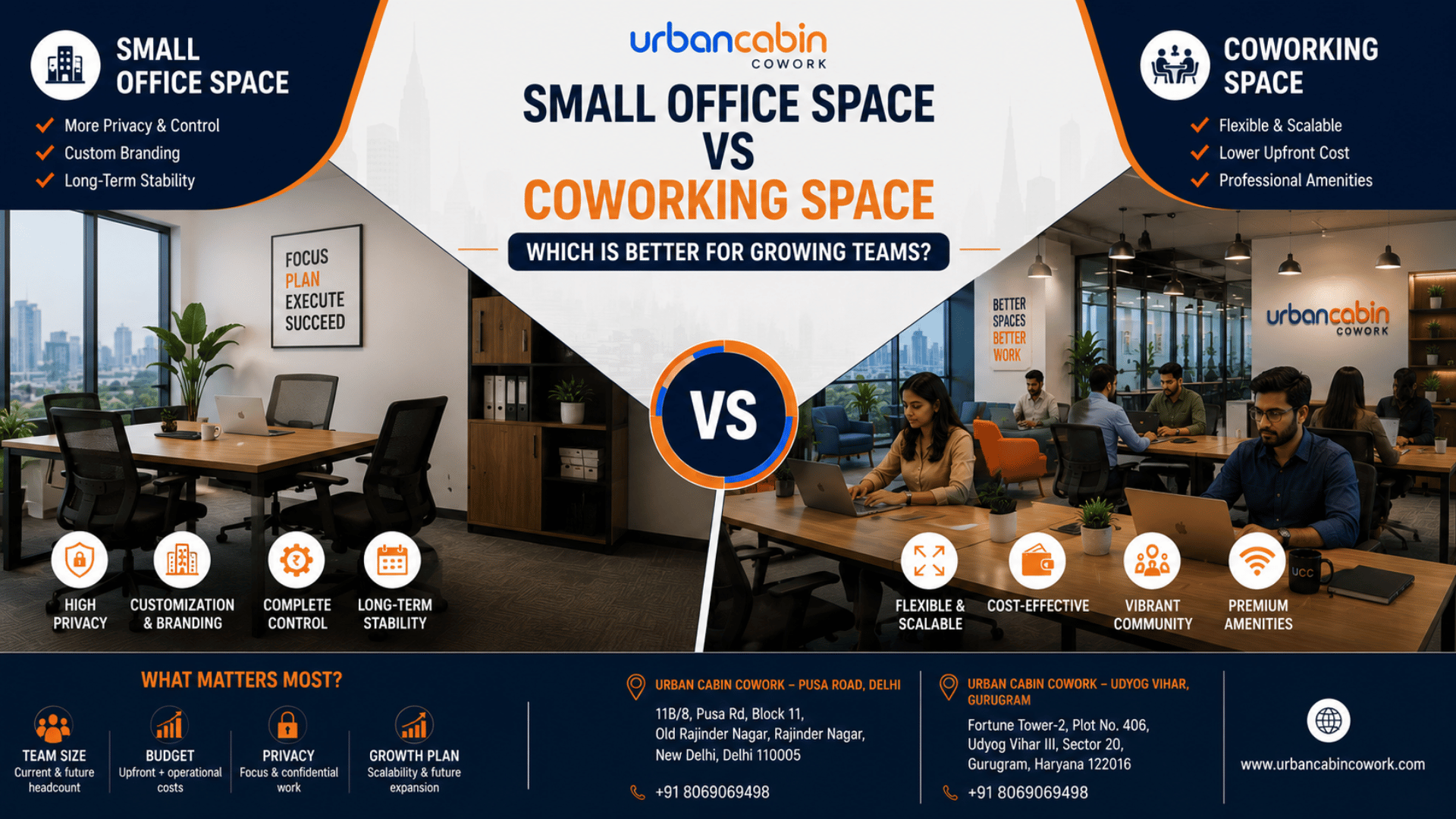
Small Office Space vs Coworking Space
Small Office Space vs Coworking Space: Which Is Better for Growing Teams?
For most growing teams, coworking space offers greater flexibility, faster setup, and lower operational complexity, while a small office provides more privacy, control, and branding opportunities. The right choice depends on your team size, growth rate, budget, privacy requirements, and how long you expect to occupy the workspace.
The key question is not simply, “Which is cheaper?” It is “Which workspace can support our team as it grows?”
What Is the Difference Between a Small Office Space and a Coworking Space?
A small office space is a dedicated workspace leased or rented by one business. It gives a team greater control over its layout, branding, privacy, furniture, and daily environment.
A coworking space is a flexible workspace where individuals and businesses share professional infrastructure. Depending on the provider, businesses can choose flexi desks, dedicated desks, private cabins, meeting rooms, or larger managed offices.
For growing businesses, coworking can provide a useful middle ground between working from home and committing to a traditional office.
Small Office Space vs Coworking Space: Quick Comparison
| Factor | Small Office | Coworking Space |
| Upfront investment | Usually higher | Usually lower |
| Setup time | Longer | Faster |
| Flexibility | Lower | Higher |
| Privacy | High | Varies by workspace type |
| Branding | High | Moderate to high with private spaces |
| Scalability | Requires planning | Generally easier |
| Amenities | Self-managed | Shared/provided |
| Community | Limited | Stronger |
| Operational burden | Higher | Lower |
A traditional small office can make sense for a stable team that needs complete control. Coworking is often more suitable for businesses whose headcount or workspace requirements may change.
Is Coworking Space More Cost-Effective Than a Small Office?
Coworking can be more cost-effective when you consider the total cost of operating an office, rather than rent alone.
A small office may involve:
- Security deposit
- Interior and fit-out costs
- Furniture
- Internet installation
- Electricity and utilities
- Maintenance
- Housekeeping
- Office equipment
- IT infrastructure
With coworking, many of these requirements are incorporated into the workspace offering, although pricing and inclusions vary by provider.
The important metric is Total Cost of Occupancy (TCO). TCO is the complete cost of maintaining a workspace, including rent, deposits, fit-out, furniture, utilities, technology, maintenance, and other operating expenses.
For a growing startup, avoiding a large upfront setup can preserve capital for hiring, product development, marketing, and other business priorities.
Which Is More Flexible for a Growing Team?
Coworking is generally more flexible when team size changes frequently.
Consider a startup that grows from five employees to ten and eventually twenty. With a conventional office, the company may need to redesign the space, renegotiate its lease, or relocate.
A flexible workspace can allow the business to increase its workspace capacity as requirements change.
A typical growth path could look like:
Flexi desk → Dedicated desk → Private cabin → Larger private office
This makes workspace scalability particularly useful for startups, SMEs, hybrid teams, and rapidly expanding businesses.
Which Provides More Privacy?
A dedicated small office normally provides the highest level of privacy and control.
However, coworking does not necessarily mean working at an open desk. Professional coworking providers may offer private cabins, meeting rooms, dedicated desks, and other private workspace options.
Teams handling client information, financial documents, legal work, or confidential discussions should evaluate:
- Private workspace availability
- Meeting rooms
- Access controls
- Noise management
- Data and document security practices
The right coworking environment can therefore provide flexibility without requiring a completely open workspace.
Which Is Better for Productivity?
Neither option automatically guarantees higher productivity.
Productivity depends on whether the workspace provides the conditions your team needs, including:
- Reliable internet
- Comfortable furniture
- Appropriate noise levels
- Meeting facilities
- Private spaces
- Ergonomic workstations
- Professional surroundings
A small office offers greater control over the environment, while coworking can provide professional infrastructure without requiring the business to manage every operational detail.
What Are the Hidden Costs of Renting a Small Office?
The advertised monthly rent is only one part of the cost.
Businesses should also consider:
- Security deposits
- Office interiors
- Furniture
- Internet and networking
- Electricity
- Maintenance
- Housekeeping
- Repairs
- IT support
- Office equipment
For a new business, these costs can create a significant initial investment.
Coworking reduces much of this setup burden because the workspace is already operational when the team moves in.
What Are the Limitations of Coworking Spaces?
Coworking is not ideal for every business.
Potential limitations include:
- Shared environments
- Noise or distractions
- Less control over common areas
- Limited customization
- Meeting-room availability during busy periods
- Potential privacy concerns in open areas
The solution is to choose a workspace based on actual business requirements rather than assuming that every coworking space offers the same environment.
For teams requiring greater privacy, private cabins or managed offices can provide a dedicated workspace while retaining the convenience of a flexible workspace provider.
When Should a Growing Team Choose a Small Office?
A small office may be the better choice when:
- Your team size is relatively stable.
- Privacy is critical.
- You need extensive branding.
- You require specialized infrastructure.
- You expect long-term occupancy.
- You want complete control over the workspace.
- Your business has predictable space requirements.
For an established team with stable headcount and long-term plans, the additional control of a dedicated office may justify the higher setup and operational responsibilities.
When Should a Growing Team Choose Coworking?
Coworking is often a better fit when:
- Your team is growing quickly.
- You want to minimize upfront investment.
- You need flexible workspace options.
- You want to start working immediately.
- You need professional meeting facilities.
- Your team follows a hybrid model.
- You want access to business amenities without managing them yourself.
- You may need more or fewer seats in the future.
For startups and small businesses, this flexibility can be particularly valuable because workspace requirements often change alongside business growth.
Is There a Middle Ground Between a Small Office and Coworking?
Yes. Private cabins, managed offices, and serviced offices can combine the privacy of a dedicated office with the convenience of a flexible workspace.
For example, a growing team may use a private cabin for focused work while accessing shared meeting rooms, reception facilities, internet infrastructure, and other professional amenities.
This approach can be useful for businesses that have outgrown open coworking but are not ready for the cost and commitment of a conventional office lease.
Which Workspace Is Better for Different Team Sizes?
| Team size | Suitable option | Why |
| 1–3 | Flexi or coworking desk | Maximum flexibility |
| 4–8 | Dedicated desks/private cabin | Balance of collaboration and privacy |
| 8–20 | Private cabin/managed workspace | Dedicated team environment |
| 20–50 | Managed/private office | Greater privacy and scalability |
| 50+ | Managed or traditional office | Greater customization may be valuable |
These are practical guidelines rather than fixed rules. Your industry, budget, privacy requirements, and growth plans should determine the final decision.
Small Office Space vs Coworking Space in Delhi and Gurugram
For growing businesses in Delhi NCR, location, accessibility, team size, and flexibility are important when choosing between a small office and coworking space.
1. Urban Cabin Cowork – Pusa Road, New Delhi
- Address: 11B/8, Pusa Rd, Block 11, Old Rajinder Nagar, Rajinder Nagar, Delhi, 110005
- Phone: +91 8069069498
- Hours: Open daily, closes at 8 PM
- Best for: Startups, freelancers, SMEs, and teams looking for a central Delhi workspace.
2. Urban Cabin Cowork – Udyog Vihar, Gurugram
- Address: Fortune Tower-2, Plot No. 406, Udyog Vihar III, Sector 20, Gurugram, Haryana 122016
- Phone: +91 8069069498
- Hours: Open daily, closes at 8 PM
- Best for: Startups, SMEs, agencies, and teams operating in Gurugram and Delhi NCR.
What Should You Consider?
- Employee commute: Choose a location convenient for your team.
- Client accessibility: Consider how easily clients can reach you.
- Team size: Select workspace capacity based on current and future needs.
- Meeting requirements: Check access to professional meeting rooms.
- Flexibility: Consider whether you may need additional desks or private space as you grow.
The best workspace is not simply the one with the lowest rent; it is the one that fits your team’s location, budget, privacy, and growth requirements.
How Should You Choose Between a Small Office and Coworking Space?
Ask these seven questions:
- How many employees do we have today?
- How quickly will the team grow?
- How much privacy do we need?
- What is our total workspace budget?
- How long do we expect to stay?
- Do we need a highly branded environment?
- How much office management do we want to handle ourselves?
Choose coworking when flexibility, speed, scalability, and lower setup complexity are priorities. Choose a small office when privacy, control, branding, and long-term stability are more important.
If you need privacy and flexibility together, consider a private cabin, managed office, or serviced workspace.
Final Verdict: Small Office Space vs Coworking Space
There is no universal winner in the small office space vs coworking space debate.
A small office is better when your team needs maximum privacy, control, customization, and long-term stability. Coworking is often better for growing teams that value flexibility, faster setup, professional infrastructure, and the ability to scale workspace as headcount changes.
For businesses that want privacy without giving up flexibility, private cabins and managed workspaces offer a practical middle ground.
For growing teams in Delhi NCR, Urban Cabin Cowork provides flexible workspace options designed around different stages of business growth—from coworking desks and dedicated desks to private cabins, meeting rooms, and managed workspace solutions.
FAQs about Small Office Space vs Coworking Space
Is a small office better than coworking for a growing team?
Coworking is often better for rapidly growing teams because it provides flexible workspace options and can reduce the setup burden. A small office may be better when privacy, branding, and long-term control are more important.
Is coworking cheaper than renting a small office?
Coworking can be more cost-effective when you consider deposits, interiors, furniture, utilities, maintenance, and other office expenses. The actual cost depends on team size, location, membership terms, and the services included.
What is the main difference between a small office and coworking space?
A small office gives one business a dedicated environment with greater control and privacy. Coworking provides flexible workspace access with shared infrastructure, amenities, and different workspace options.
Is coworking good for a team of 5 to 10 people?
Yes. A team of five to ten people can use dedicated desks, private cabins, or other team workspace options depending on its privacy and collaboration requirements.
What should I choose if my team may double in size within a year?
Choose a workspace that can add capacity without forcing an immediate relocation or major setup investment. Flexible coworking or managed workspace can be suitable for this type of growth.
Explore Coworking Spaces in Delhi NCR
Looking for a Coworking Space in Delhi NCR? Discover top-rated options across the city:
Coworking Space in Central Delhi | Coworking Space on Pusa Road | Coworking Space in Jhandewalan | Coworking Space in Karol Bagh | Coworking Space in Rajendra Place | Coworking Space in Old Rajinder Nagar | Coworking Space in Connaught Place | Coworking Space in Gurugram | Coworking Space in Udyog Vihar



Leave a Reply