

How to Choose an Office Space in Delhi for Business Expansion
How to Choose an Office Space in Delhi for Business Expansion
Choosing the right office for a company expanding into Delhi requires evaluating location, employee accessibility, workspace requirements, total occupancy costs and future growth. Businesses should compare commercial locations, assess different office formats and understand the operational responsibilities involved before committing to a workspace.
Delhi offers several commercial districts for businesses establishing a new office or expanding their operations. However, the right location depends on the company’s industry, team size, client requirements and expansion strategy.
Whether you are a startup opening your first Delhi office, an established company setting up a regional branch or a growing business relocating its operations, this guide explains how to choose office space in Delhi.
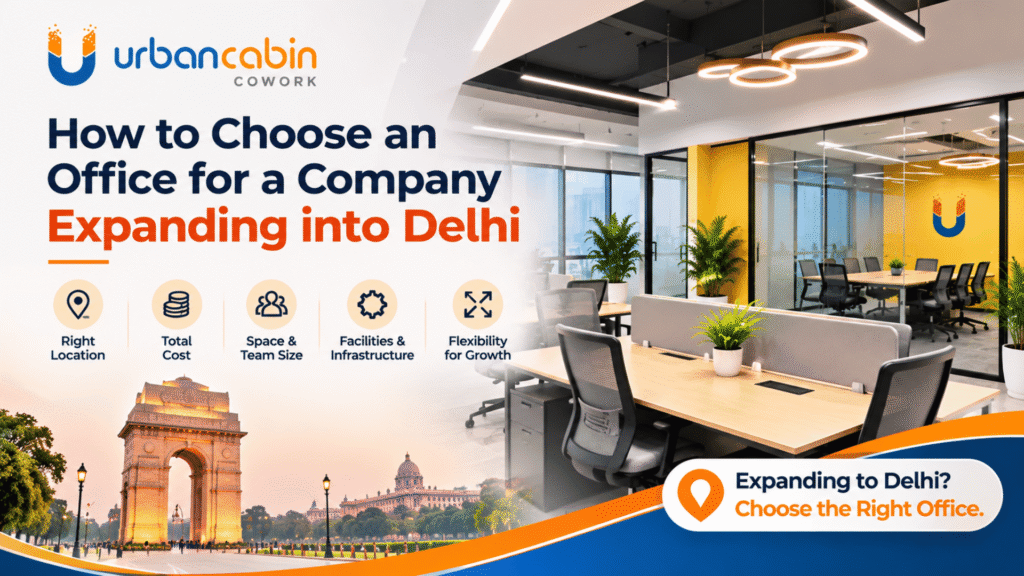
Why Is Choosing the Right Office Important When Expanding into Delhi?
Choosing the right office is important because it influences business operations, employee commuting, client accessibility and long-term occupancy costs.
A suitable office can help a company establish a professional presence, bring employees together and create an environment for collaboration. An unsuitable location or workspace arrangement, on the other hand, may increase operating expenses or create difficulties as the business grows.
Delhi NCR continues to be an important office market for businesses. According to Savills’ H1 2026 office-market report, Delhi NCR recorded 6.2 million square feet of gross office absorption, with Gurugram contributing 57%, Noida 29% and Delhi 14%. These figures demonstrate why businesses should distinguish between Delhi and the wider NCR when evaluating office locations.
Source: Savills – Delhi NCR Office Market Watch, H1 2026.
For an expanding company, office selection should therefore be treated as a strategic business decision rather than simply a property-rental exercise.
1. What Should a Company Consider Before Choosing an Office in Delhi?
A company should define its operational requirements, team size, budget and expected growth before searching for office space.
Starting with these requirements makes it easier to shortlist suitable locations and avoid paying for facilities that the business does not need.
Identify the Purpose of Your New Office
First, determine why your company needs a physical presence in Delhi.
Your office may be intended for:
- Establishing a regional headquarters.
- Setting up a sales or business development team.
- Managing customer support and administrative operations.
- Opening a branch office.
- Supporting a hybrid or remote workforce.
- Conducting client meetings and business development activities.
For example, a company establishing a client-facing regional office may prioritise meeting facilities and accessibility. A business setting up a small operational team may focus more on seating capacity, internet connectivity and occupancy costs.
Estimate Your Current and Future Team Size
Calculate how many employees will use the office regularly. Consider daily attendance rather than relying only on total employee headcount, particularly if your company follows a hybrid working model.
Also account for future recruitment, visiting employees, meeting spaces and temporary project teams.
Create a List of Essential Office Requirements
Before contacting workspace providers or property owners, prepare a list of requirements such as:
- Workstations and private cabins.
- Meeting and conference rooms.
- Reliable internet connectivity.
- Power backup.
- Reception and visitor management.
- Parking and transport accessibility.
- Security and maintenance arrangements.
This list will help you compare office options using consistent criteria.
2. Which Is the Best Location in Delhi for a New Company Office?
The best office location in Delhi depends on your company’s industry, employee commuting patterns, customer base, budget and operational priorities.
Delhi has several established commercial districts, each offering different advantages. Businesses should evaluate these areas based on their actual requirements rather than selecting a location solely because it is popular.
Major Commercial Locations to Consider
| Business location | Potential business suitability | What to evaluate |
| Connaught Place | Professional services and client-facing businesses | Commercial positioning, accessibility and occupancy costs |
| Nehru Place | IT, consulting and service businesses | Connectivity, building infrastructure and workspace availability |
| Pusa Road / Rajendra Place | Businesses seeking a central or west-central Delhi location | Metro access, employee convenience and workspace options |
| Aerocity | Businesses prioritising airport connectivity | Travel requirements and overall occupancy costs |
| Okhla | Businesses comparing commercial and operational locations | Building facilities, accessibility and budget |
| Jasola | Companies considering South Delhi commercial districts | Employee commute patterns and infrastructure |
| Saket | Businesses seeking a South Delhi commercial location | Client accessibility and workspace suitability |
This is a shortlist of areas to investigate, not a ranking of the best office locations. Actual suitability depends on the specific building, transport connections and business requirements.
Consider Employee and Client Accessibility
An office should be convenient for the people who use it. Evaluate:
- Distance from the nearest metro station.
- Public transport availability.
- Road connectivity during peak hours.
- Parking arrangements.
- Accessibility for clients and business partners.
The Delhi Metro Rail Corporation publishes official network maps and station information. Businesses should use the latest network information to verify routes and connections when evaluating a shortlisted property.
Source: Delhi Metro Rail Corporation – Official Network Map.
Should You Choose Delhi or Gurugram?
Some companies expanding into the capital region may also consider Gurugram or Noida.
The decision should depend on where employees live, where clients operate, the nature of business activities and the overall cost of establishing an office.
Delhi and Delhi NCR should not be treated as identical office markets. Compare specific locations and buildings rather than making a decision based only on the city name.
3. How Much Office Space Does an Expanding Company Need?
The amount of office space a company needs depends on employee attendance, workstation requirements, meeting facilities, office layout and expected recruitment.
There is no single office size that suits every expanding business.
Calculate Your Seating Requirements
Start with the number of employees expected to attend simultaneously.
For example, a company with 20 employees following a hybrid working arrangement may not require 20 permanently occupied workstations if attendance is staggered. However, it must account for peak attendance days and collaboration requirements.
Account for Shared and Common Areas
An office requires more than desks. Consider space for:
- Meeting rooms.
- Reception and waiting areas.
- Collaboration zones.
- Storage.
- Pantry and break areas.
- Private discussion spaces.
The final layout should support both individual work and team interaction.
Plan for Future Recruitment
If your company expects to hire more employees over the next year or two, evaluate whether the office can accommodate additional workstations or whether a larger configuration will be available.
Choosing an office that supports future changes can reduce the need for frequent relocation.
4. How Much Does It Cost to Set Up an Office in Delhi?
The total cost of setting up an office in Delhi includes more than monthly rent. Companies should consider deposits, maintenance, utilities, furniture, interiors, internet and ongoing operational expenses.
Direct Office Occupancy Costs
Depending on the property and agreement, these may include:
- Monthly rent or workspace charges.
- Security deposit.
- Maintenance and common-area charges.
- Electricity and water.
- Internet and communication services.
- Parking charges, where applicable.
Office Setup and Operational Costs
Traditional office arrangements may also require investment in:
- Furniture and workstations.
- Interior fit-outs.
- IT equipment and networking.
- Electrical installations.
- Housekeeping.
- Repairs and maintenance.
- Facility management.
The exact cost depends on the building, workspace format, agreement and services included.
Compare Total Occupancy Costs Instead of Rent Alone
Consider a simple example.
A conventional office may have a lower quoted monthly rent but require additional spending on furniture, interiors and ongoing maintenance.
A furnished workspace may have a different monthly pricing structure while reducing some initial setup responsibilities.
Therefore, businesses should compare the complete financial commitment over the expected occupancy period.
A useful rule: Ask every property owner or workspace provider for a written breakdown of one-time charges, recurring charges, included services and additional costs.
5. Which Office Format Is Best for a Company Expanding into Delhi?
The most suitable office format depends on team size, privacy requirements, budget, expected occupancy period and the level of operational control required.
Companies can generally compare four options: traditional offices, coworking spaces, serviced offices and managed offices.
Traditional Office Space
A traditional office provides greater control over the layout, interiors, branding and daily workspace arrangements.
It may suit established companies with stable teams and specific infrastructure requirements.
However, depending on the property agreement, the business may need to manage fit-outs, furniture, utilities, maintenance and other operational responsibilities.
Coworking Space
A coworking space provides access to a shared professional working environment.
It may suit:
- Startups entering Delhi.
- Small teams establishing a new market presence.
- Remote employees requiring a professional workspace.
- Companies testing a new location before committing to a larger office.
Workspace options, pricing and flexibility depend on the provider’s terms.
Serviced Office
A serviced office generally provides furnished workspace with supporting facilities and services.
It may be appropriate for companies that want a ready-to-use working environment without independently managing every aspect of office setup.
Businesses should confirm which facilities and services are included in the agreement.
Managed Office
A managed office is generally arranged around a company’s specific workspace and operational requirements.
It may suit businesses seeking a dedicated office environment with support for workspace management.
The level of customisation, services and operational responsibility varies by provider.
Office Format Comparison
| Factor | Traditional office | Coworking space | Serviced office | Managed office |
| Workspace arrangement | Independently arranged | Shared or dedicated options | Furnished workspace | Dedicated managed workspace |
| Setup responsibility | Often higher | Depends on provider | Often lower | Depends on agreement |
| Customisation | Generally greater | Usually more limited | Varies | Often more flexible |
| Operational management | Company-managed or outsourced | Provider-dependent | Usually includes supporting services | Defined by service agreement |
| Potential suitability | Established operations | Startups and smaller teams | Businesses seeking ready-to-use space | Companies requiring dedicated workspace |
The categories can overlap in practice. Always compare the actual services, facilities and contractual responsibilities instead of relying only on the office-format label.
6. What Facilities Should You Check Before Renting an Office in Delhi?
A suitable office should have the infrastructure required for smooth daily operations. Companies should inspect the premises and confirm which facilities are included before signing an agreement.
Use this checklist:
| Facility | What to verify |
| Internet | Available service, speed options and reliability |
| Power backup | Backup arrangements and limitations |
| Meeting rooms | Availability, capacity and booking conditions |
| Reception | Visitor management and guest access |
| Security | Entry procedures and building security |
| Maintenance | Cleaning, repairs and maintenance responsibilities |
| Parking | Availability and applicable charges |
| Accessibility | Metro, road and public transport connections |
Do not assume that every facility is included in the quoted rent or workspace fee. Request written confirmation of the services covered by the agreement.
7. How Can a Company Choose an Office That Supports Future Growth?
A company should choose an office that meets its current requirements while allowing reasonable flexibility as its operations expand.
When entering Delhi, a business may begin with a small team and later add new departments, employees or client-facing functions.
Consider these questions:
- Can the workspace accommodate additional employees?
- Are larger office configurations available?
- Can the company move from shared desks to private cabins?
- Are additional meeting facilities accessible?
- Can the workspace arrangement change as business requirements evolve?
- Are renewal, notice and exit conditions clearly defined?
Flexible workspace arrangements may be useful for businesses whose team sizes or operational needs are changing. However, flexibility should be confirmed through the actual agreement.
The objective is to avoid committing to more space than necessary while ensuring that the company has a practical route to expand.
8. Office Selection Checklist for Companies Expanding into Delhi
Before finalising an office, compare shortlisted locations using the same evaluation criteria.
Essential Office Selection Checklist
- The location is convenient for employees and clients.
- Metro and public transport access have been checked.
- The office supports current employee attendance.
- There is sufficient capacity for planned recruitment.
- Total occupancy costs are clearly explained.
- Internet and power arrangements meet business requirements.
- Meeting and conference facilities are suitable.
- Maintenance and security responsibilities are defined.
- Deposit, renewal and agreement terms are understood.
- Exit conditions and additional charges are documented.
Office Selection Scorecard
Businesses can use the following weighted scorecard to compare shortlisted offices.
| Selection factor | Suggested weight |
| Location and connectivity | 25% |
| Total occupancy cost | 20% |
| Team size and layout | 20% |
| Facilities and infrastructure | 15% |
| Future expansion flexibility | 15% |
| Lease terms | 5% |
| Total | 100% |
These weights are a suggested decision-making framework, not an industry benchmark. A company with a large client-facing team may give greater importance to location, while a business with a limited budget may prioritise total occupancy costs.
9. Why Consider Urban Cabin Cowork for Your Delhi Office Expansion?
Urban Cabin Cowork provides flexible workspace options for professionals, startups, freelancers, remote teams and businesses looking for a professional working environment in Delhi.
Its Delhi location is:
Urban Cabin Cowork – Pusa Road
11B/8, Pusa Road, Block 11, Old Rajinder Nagar, Rajinder Nagar, Delhi 110005.
Workspace solutions include coworking desks, private cabins, meeting rooms and serviced workspace options, subject to current availability and booking arrangements.
Businesses exploring a Delhi office can enquire about workspace configurations and discuss their requirements before deciding.
Contact Urban Cabin Cowork:
- Website: https://urbancabincowork.com/
- Phone: +91 8069069498
- Email: connect@urbancabincowork.com
Whether you are establishing a small team or exploring a professional workspace for your expanding operations, comparing available options can help you make a more informed decision.
Conclusion: Choose an Office That Supports Your Company’s Growth
Choosing an office for a company expanding into Delhi requires more than finding an attractive rental price. Businesses should evaluate location, employee accessibility, workspace size, total occupancy costs, infrastructure and future expansion requirements.
The best office is the one that aligns with your company’s operational needs and growth strategy. Compare traditional, coworking, serviced and managed office options before making a commitment.
With a clear selection process and a practical understanding of your requirements, your company can establish a professional presence in Delhi while making a workspace decision that supports its next stage of growth.
Explore Coworking Spaces in Delhi NCR
Looking for a Coworking Space in Delhi NCR? Discover top-rated options across the city:
Coworking Space in Central Delhi | Coworking Space on Pusa Road | Coworking Space in Jhandewalan | Coworking Space in Karol Bagh | Coworking Space in Rajendra Place | Coworking Space in Old Rajinder Nagar | Coworking Space in Connaught Place | Coworking Space in Gurugram | Coworking Space in Udyog Vihar | Meeting Room Rental in Delhi | Meeting Room Rental in Gurugram
FAQs About How to Choose an Office Space in Delhi for Business Expansion
How should a company choose an office when expanding into Delhi?
A company should evaluate its business requirements, employee commuting patterns, commercial locations, workspace size, total occupancy costs and future hiring plans. Comparing office formats and inspecting shortlisted premises can help identify the right workspace.
Which is the best location in Delhi for a new company office?
The best location depends on the company’s industry, employees, clients and budget. Connaught Place, Nehru Place, Pusa Road, Aerocity, Okhla, Jasola and Saket are among the areas businesses can evaluate.
How much office space does an expanding company need?
Office space requirements depend on the number of employees attending simultaneously, workstation layout, meeting facilities and future hiring plans. Companies should estimate actual occupancy instead of relying only on total employee headcount.
What costs should businesses consider when renting an office in Delhi?
Businesses should consider rent, security deposits, maintenance charges, utilities, internet, furniture, interior setup, housekeeping, repairs and other applicable expenses. Comparing total occupancy costs gives a more realistic view than comparing rent alone.

Leave a Reply