

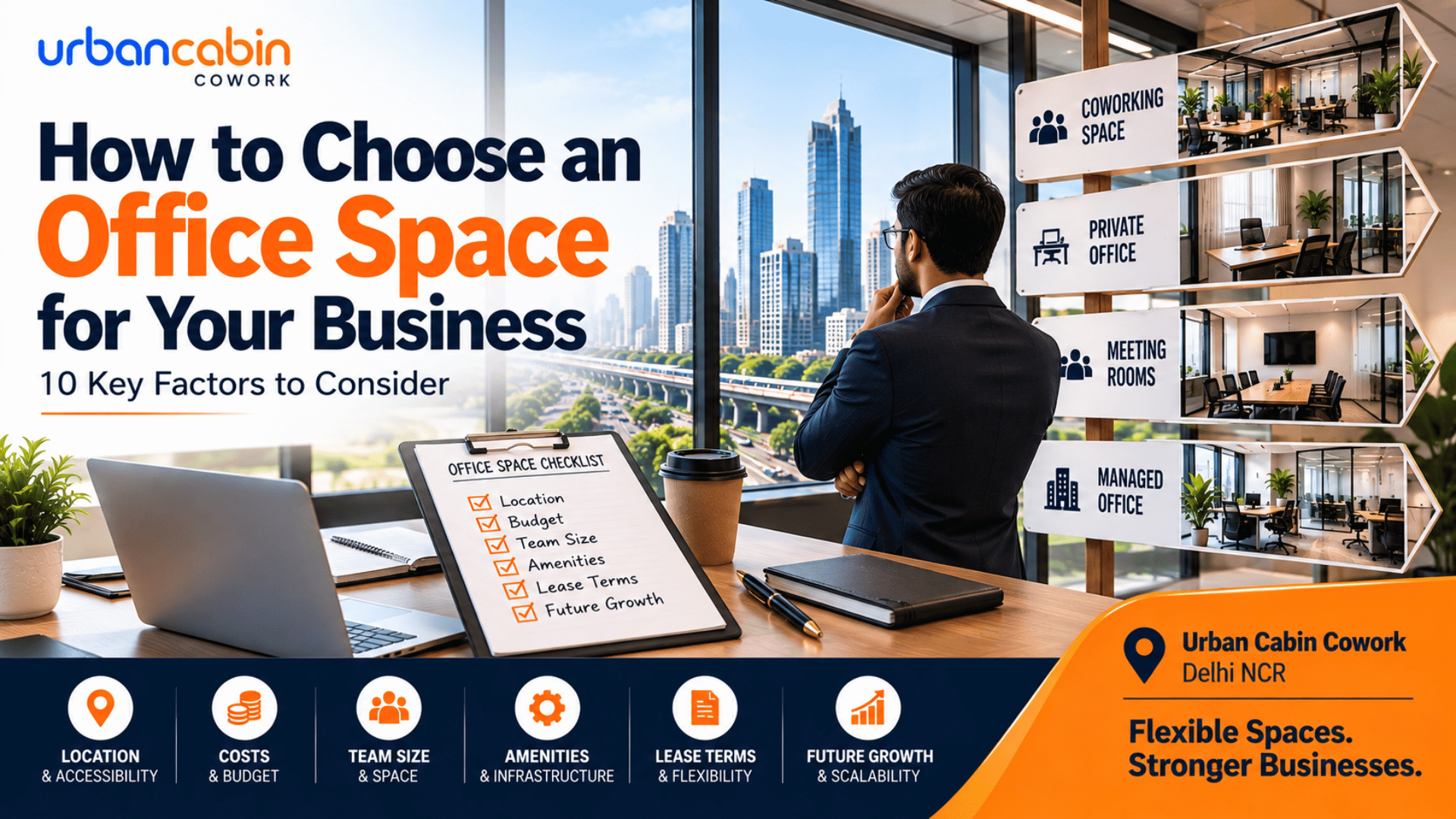
How to Choose an Office Space
How to Choose an Office Space for Your Business
Choosing the right office space requires evaluating your budget, location, team size, infrastructure, lease terms, and future growth plans. The best office should support employee productivity, provide essential facilities, and fit your business needs without creating unnecessary operating costs.
For startups, SMEs, freelancers, and growing teams in Delhi NCR, comparing coworking spaces, private offices, managed offices, and traditional offices can help identify the most practical solution.
What Factors Should You Consider When Choosing Office Space?
Before renting an office, assess how your team works, what facilities it needs, and how much your business can afford. The following factors can help you make an informed decision.
1. Does the Location Suit Your Employees and Clients?
Office location affects employee commute times, client accessibility, and daily operations. Choose a location that is convenient for your employees and provides suitable access to public transport, major roads, parking, and essential business services.
Businesses operating in Delhi NCR should consider their workforce distribution and client locations when comparing areas in New Delhi and Gurugram. For example, a company whose employees regularly meet clients in Gurugram may benefit from an office close to its clients and business partners.
Before finalising a location, consider:
- Public transport connectivity and commute times.
- Availability of parking and nearby amenities.
- Accessibility for employees, clients, and visitors.
- Proximity to customers, suppliers, and business partners.
- Safety, accessibility, and the surrounding business environment.
The right location balances convenience, operational requirements, and overall occupancy costs.
2. How Much Office Space Does Your Team Need?
The amount of office space your business needs depends on employee headcount, attendance patterns, workstation requirements, meeting facilities, and future hiring plans.
Start by estimating the number of employees who will work from the office simultaneously. Then account for meeting rooms, private cabins, collaborative areas, storage, and circulation space.
A fully office-based team may need a different layout from a hybrid team whose employees visit on selected days. Businesses with frequent client meetings may also require dedicated meeting rooms or private offices.
Before choosing an office, determine:
- How many workstations are required?
- Will employees work from the office every day?
- Do teams need private cabins or confidential calling areas?
- How much meeting and collaboration space is necessary?
- Will the office accommodate planned recruitment?
Avoid paying for unused space, but do not compromise on comfort or functionality to minimise rent. A suitable office layout should support both current operations and realistic growth plans.
3. What Is the Total Cost of Occupying an Office?
Office selection should be based on total occupancy cost rather than monthly rent alone. Depending on the property and agreement, additional expenses may include security deposits, maintenance charges, utilities, internet, furniture, interior fit-outs, repairs, and cleaning.
Traditional offices may require substantial initial setup, while coworking and managed office arrangements may include some facilities and services within a package. The actual cost depends on the provider, contract, and services included.
Compare these expenses before making a decision:
- Monthly rent or workspace membership fees.
- Security deposits and applicable advance payments.
- Furniture, equipment, and interior setup.
- Electricity, internet, maintenance, and cleaning.
- Meeting-room usage and additional service charges.
- Relocation costs and contractual exit obligations.
Ask each provider for a written breakdown of charges and inclusions. Comparing the total cost over the expected occupancy period provides a more reliable basis for selecting an office.
4. What Amenities and Infrastructure Should an Office Have?
The right office infrastructure depends on your team’s daily activities. Reliable internet, power backup, comfortable workstations, and suitable security arrangements are important for most businesses.
Companies that handle confidential information may also require private cabins, controlled access, or dedicated meeting rooms. Teams that regularly conduct presentations or client meetings should evaluate the availability of appropriate meeting facilities.
Check for:
- Reliable internet connectivity and power backup.
- Comfortable furniture and suitable lighting.
- Meeting rooms and collaboration areas.
- Building security and access controls.
- Clean washrooms and maintained common areas.
- Appropriate privacy for confidential conversations.
- Accessibility and other facilities relevant to your employees.
Prioritise the facilities your business genuinely needs. A workspace with the right infrastructure can help employees work more efficiently and reduce the need to arrange essential services separately.
Which Office Space Type Is Best for Your Business?
The best office type depends on your budget, privacy requirements, preferred level of control, and ability to manage office operations.
| Office type | Best suited for | Main consideration |
| Traditional office | Businesses wanting direct control over their premises | Setup costs, maintenance, and lease commitments |
| Coworking space | Freelancers, startups, and small teams | Shared facilities and membership terms |
| Private office | Teams requiring dedicated workspace | Capacity, privacy, and included services |
| Managed office | Businesses seeking a professionally managed workspace | Service scope, customisation, and contract terms |
| Serviced office | Teams wanting ready-to-use office facilities | Pricing structure and included amenities |
A coworking space can provide access to shared facilities without requiring a business to manage an entire office independently. A private office offers dedicated space, while a managed office may provide a more tailored arrangement with services handled by the operator.
A traditional office may suit businesses that need greater control over their premises and are prepared to manage setup and maintenance.
Urban Cabin Cowork offers workspace solutions including coworking desks, private cabins, meeting rooms, serviced offices, and managed office options. Businesses can evaluate these alternatives according to their requirements and confirm the applicable services and terms before choosing a workspace.
For a deeper comparison, read Managed Office vs Serviced Office: Which Workspace Is Right for You?.
What Should You Check Before Renting an Office Space?
An office inspection checklist helps you compare properties consistently and identify potential problems before signing an agreement.
Use the following checklist when visiting shortlisted offices.
- Confirm the complete monthly cost and all additional charges.
- Review the security deposit, lock-in period, renewal terms, and exit clause.
- Test internet connectivity and confirm power backup arrangements.
- Inspect the workstations, meeting rooms, washrooms, and common areas.
- Check building security, access arrangements, and operating hours.
- Confirm which furniture, utilities, and services are included.
- Verify parking availability and public transport accessibility.
- Ask about maintenance responsibilities and repair procedures.
- Check whether additional workstations can be accommodated as your team grows.
- Obtain the agreed costs, inclusions, and restrictions in writing.
What Questions Should You Ask Before Signing an Office Agreement?
Ask the landlord or workspace provider about the total cost, deposit refund conditions, minimum commitment, renewal process, maintenance responsibilities, and permitted office usage.
You should also clarify whether meeting rooms, internet, utilities, furniture, and other facilities are included or charged separately. Review the agreement carefully and seek professional advice where necessary, particularly if the contract contains complex financial or legal obligations.
A thorough review can help prevent unexpected expenses and misunderstandings after moving in.
How Can You Choose an Office That Supports Future Growth?
Choose an office that meets your current requirements without making future expansion unnecessarily difficult. Consider your recruitment plans, expected changes in attendance, and the possibility of needing additional workstations or private cabins.
Flexible workspace arrangements may be useful for startups and growing businesses because they can offer alternatives to committing to a larger conventional office immediately. However, expansion options depend on available capacity, membership conditions, and contractual terms.
Before deciding, ask whether you can increase your workspace, change your office configuration, or access additional meeting facilities as your requirements evolve.
The objective is to select a workspace that supports business growth while keeping costs and operational responsibilities manageable.
What Is the Best Way to Compare Office Spaces?
The best way to compare office spaces is to score each shortlisted property against the factors that matter most to your business. This creates a consistent comparison instead of relying on rent or appearance alone.
Use this simple decision framework:
| Evaluation factor | Suggested importance |
| Total occupancy cost | 25% |
| Location and accessibility | 20% |
| Space and layout | 15% |
| Infrastructure and amenities | 15% |
| Contract flexibility | 10% |
| Privacy and security | 10% |
| Expansion potential | 5% |
| Total | 100% |
These weights are illustrative and should be adjusted to suit your business. For example, a company handling sensitive client information may give privacy and security greater importance.
Score each office from 1 to 5 for every factor, multiply each score by its assigned weight, and compare the results. Use the scores alongside your inspection findings and contract review to make the final decision.
Conclusion: How to Choose an Office Space
Choosing the right office space requires balancing location, cost, team requirements, infrastructure, and long-term flexibility. Compare workspace types, inspect shortlisted properties, and review all contractual obligations before making a commitment.
If you are exploring flexible workspace solutions in Delhi NCR, Urban Cabin Cowork offers options including coworking desks, private cabins, meeting rooms, and managed office solutions. Explore the available options at Urban Cabin Cowork to identify a workspace that aligns with your business needs.
Explore Coworking Spaces in Delhi NCR
Looking for a Coworking Space in Delhi NCR? Discover top-rated options across the city:
Coworking Space in Central Delhi | Coworking Space on Pusa Road | Coworking Space in Jhandewalan | Coworking Space in Karol Bagh | Coworking Space in Rajendra Place | Coworking Space in Old Rajinder Nagar | Coworking Space in Connaught Place | Coworking Space in Gurugram | Coworking Space in Udyog Vihar



Leave a Reply