

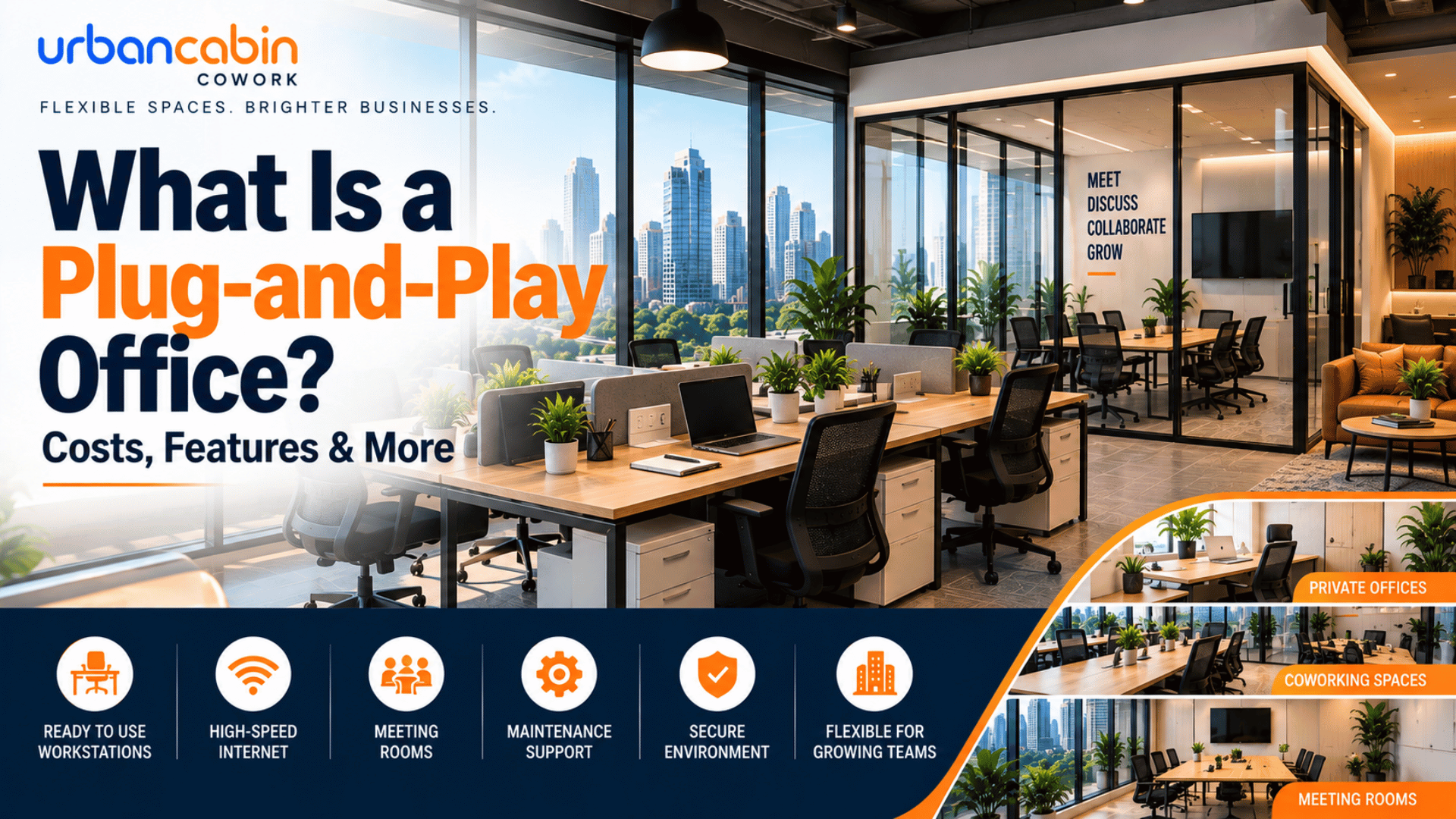
What Is a Plug-and-Play Office
What Is a Plug-and-Play Office? Costs, Features and Benefits
A plug-and-play office is a ready-to-use workspace equipped with essential furniture and infrastructure, allowing businesses to start working without arranging an entire office setup from scratch. Depending on the provider, it may include workstations, high-speed internet, meeting rooms, power backup, and maintenance services. For startups, SMEs, and growing teams in Delhi NCR, plug-and-play office spaces offer a practical alternative to setting up a traditional office.
Before choosing a workspace, businesses should understand what facilities are included, how pricing works, and whether a plug-and-play office offers the right balance of convenience, flexibility, and cost.
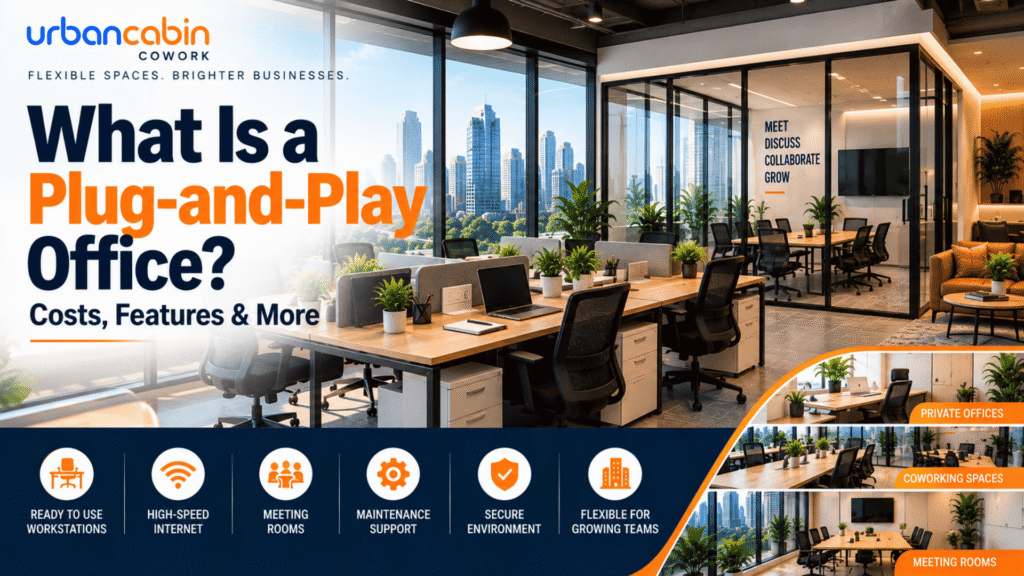
What Features Does a Plug-and-Play Office Include?
A plug-and-play office typically provides the essential facilities required to begin working with minimal setup. However, the exact amenities depend on the workspace provider, office type, and rental agreement.
Common features include:
- Ready-to-use workstations: Desks, chairs, and designated seating arrangements.
- Internet and IT infrastructure: Internet connectivity and, where provided, supporting IT facilities.
- Meeting rooms: Spaces for client discussions, team meetings, and presentations.
- Power and utilities: Electricity, lighting, air conditioning, and potentially power backup.
- Reception and common areas: Shared facilities that create a professional working environment.
- Maintenance and housekeeping: Services that may be included in the workspace package.
- Security and access controls: Building access arrangements and other security measures.
For example, a startup moving into a furnished office may avoid independently sourcing desks, chairs, and basic infrastructure. Before signing an agreement, confirm which facilities are included in the rent and which require additional payment.
What Are the Benefits of a Plug-and-Play Office?
Plug-and-play office spaces can help businesses simplify office setup, reduce initial coordination, and access professional facilities without independently arranging every component.
1. How Does a Plug-and-Play Office Save Setup Time?
A ready-to-use office can reduce the time required to purchase furniture, coordinate installations, arrange internet connectivity, and prepare the workspace. This can be particularly useful for startups launching operations or companies establishing a new team in another location.
The actual move-in time depends on availability, documentation, access permissions, and any additional requirements.
2. Can a Plug-and-Play Office Reduce Initial Expenses?
A plug-and-play office may reduce upfront spending on furniture, interiors, and infrastructure because some of these facilities are already provided. Businesses can also avoid coordinating multiple vendors for basic office requirements.
However, lower setup expenses do not automatically mean lower total occupancy costs. Monthly rent, deposits, service charges, and contract duration should all be considered.
3. Does a Plug-and-Play Office Provide a Professional Work Environment?
A well-equipped office can provide organised workstations, meeting facilities, and a suitable setting for employee collaboration and client interactions. These features can help businesses establish a professional workplace without managing an entire office independently.
4. Is a Plug-and-Play Office Suitable for Growing Teams?
Plug-and-play arrangements can suit growing teams that need an office without undertaking a complete fit-out. Some providers may offer additional seats or alternative office configurations, subject to availability and contractual terms.
This flexibility can be valuable for startups and SMEs whose workspace requirements change as their teams expand.
How Much Does a Plug-and-Play Office Cost?
The cost of a plug-and-play office depends on the location, office size, number of seats, building quality, included amenities, and rental agreement. Businesses should compare the total occupancy cost rather than relying only on the advertised monthly rent.
In Delhi NCR, pricing can vary considerably between locations such as central New Delhi, Pusa Road, and Udyog Vihar in Gurugram. A private office in a premium commercial building may have a different cost structure from a shared workspace or a smaller furnished office.
What Factors Affect Plug-and-Play Office Pricing?
The main factors influencing the cost include:
- Location: Commercial districts and well-connected business areas may command different rates.
- Office size: Larger offices and higher seat counts generally increase the total rental commitment.
- Facilities: Meeting rooms, reception services, internet, parking, and power backup may affect pricing.
- Contract duration: Longer commitments may have different rates and obligations from shorter arrangements.
- Privacy and configuration: Private cabins and dedicated offices may be priced differently from shared workstations.
- Building quality: Amenities, accessibility, infrastructure, and the overall property can influence costs.
What Additional Costs Should You Check?
Before signing an agreement, ask about the security deposit, applicable taxes, maintenance charges, utility bills, meeting-room fees, parking, and any additional service charges.
A useful comparison is to calculate the expected cost over the full occupancy period:
Total occupancy cost = Rent + setup expenses + utilities and services + applicable fees.
Adjust this calculation to avoid double-counting expenses already included in the quoted rent. Also consider deposit refund conditions and exit obligations.
For an accurate comparison, request an itemised quotation from each workspace provider. Current local rates should be verified directly because prices vary by availability, office configuration, and contract terms.
Plug-and-Play Office vs Traditional Office: What’s the Difference?
The main difference between a plug-and-play office and a traditional office is the level of readiness at the time of occupancy. A plug-and-play office is designed to be used with minimal setup, whereas a traditional office may require the tenant to arrange furniture, interiors, utilities, and other infrastructure.
| Factor | Plug-and-play office | Traditional office |
| Initial setup | Usually limited | May require furnishing and fit-outs |
| Move-in readiness | Designed for faster occupancy | Depends on property condition |
| Furniture | Often provided | May need to be purchased separately |
| Infrastructure | Some facilities may be included | May require separate arrangements |
| Customisation | Depends on provider and agreement | Often offers greater control |
| Operating responsibilities | Some services may be handled by the provider | More responsibilities may fall on the tenant |
| Cost structure | May combine rent and selected services | Rent plus setup and operating expenses |
A plug-and-play office may suit businesses that prioritise convenience and faster occupancy. A traditional office may be more appropriate for organisations that require extensive customisation, specialised infrastructure, or greater control over the premises.
The best option depends on the total cost, operational requirements, and expected duration of occupancy.
Is a Plug-and-Play Office the Same as a Managed Office?
No. A plug-and-play office describes a workspace that is ready to use, while a managed office generally refers to a workspace whose operations and services are handled by a third-party provider.
A managed office can also be plug-and-play if it is furnished and equipped for immediate use. However, not every plug-and-play office includes comprehensive management services.
For example, one office may provide furniture and internet while requiring the tenant to arrange other services. Another may include housekeeping, maintenance, reception, and additional operational support.
Before choosing either arrangement, review the agreement to understand who is responsible for utilities, repairs, security, cleaning, and day-to-day office management.
Read our guide to What Is a Managed Office Space? to understand how managed workspace arrangements work.
Who Should Choose a Plug-and-Play Office?
Plug-and-play offices can be suitable for businesses that want a functional workspace without independently managing every setup requirement.
- Startups: Teams launching operations that want to avoid extensive initial office preparation.
- Small and medium-sized businesses: Companies seeking professional facilities without coordinating a complete office fit-out.
- Corporate project teams: Organisations establishing temporary teams or additional operational locations.
- Growing companies: Businesses that need additional workstations and want to explore flexible workspace arrangements.
- Remote and hybrid teams: Companies that require a dedicated place for employees to collaborate in person.
However, businesses with specialised technical requirements, extensive customisation needs, or strict infrastructure specifications should confirm that the office can accommodate them before committing.
How Do You Choose the Right Plug-and-Play Office in Delhi NCR?
Choosing a plug-and-play office in Delhi NCR requires evaluating accessibility, total costs, facilities, privacy, and contractual flexibility. A suitable location should serve your employees and clients while meeting your operational requirements.
Use this checklist when comparing offices:
- Evaluate the location: Consider commute times, public transport, parking, and proximity to clients.
- Calculate the complete cost: Include rent, deposits, utilities, applicable taxes, and additional service charges.
- Inspect the facilities: Check furniture, internet connectivity, power backup, meeting rooms, and common areas.
- Review privacy and security: Confirm access controls and suitable arrangements for confidential work.
- Understand the agreement: Review the lock-in period, renewal conditions, deposit refund policy, and exit clauses.
- Plan for growth: Ask whether additional seats or a larger office can be arranged when required.
Businesses exploring flexible workspace solutions in New Delhi and Gurugram can also compare coworking desks, private cabins, serviced offices, and managed office arrangements.
Urban Cabin Cowork offers workspace solutions including coworking desks, private cabins, meeting rooms, serviced offices, and managed office options. Businesses can explore the available facilities and confirm the terms that apply to their requirements.
For additional guidance, read Top Things to Consider When Looking for an Office Space and Flexible Workspaces for Business Expansion in Delhi NCR.
Conclusion: Is a Plug-and-Play Office Right for Your Business?
A plug-and-play office can be a practical solution for businesses seeking a ready-to-use workspace with essential furniture and infrastructure. Before choosing one, compare the total occupancy cost, included facilities, location, contractual terms, and potential for future expansion.
If you are exploring flexible workspace solutions in Delhi NCR, Urban Cabin Cowork offers options including coworking desks, private cabins, meeting rooms, and managed office solutions. Visit Urban Cabin Cowork to explore available workspace options and find an arrangement that suits your business needs.
Explore Coworking Spaces in Delhi NCR
Looking for a Coworking Space in Delhi NCR? Discover top-rated options across the city:
Coworking Space in Central Delhi | Coworking Space on Pusa Road | Coworking Space in Jhandewalan | Coworking Space in Karol Bagh | Coworking Space in Rajendra Place | Coworking Space in Old Rajinder Nagar | Coworking Space in Connaught Place | Coworking Space in Gurugram | Coworking Space in Udyog Vihar



Leave a Reply